

The patient experience begins well before care delivery. It starts with booking the appointment, then continues when someone enters a facility, finds the registration area and begins the check-in process.
For hospitals and health systems, that first interaction can be difficult to manage consistently. Growing patient volumes, demand for convenient digital engagement and persistent staffing challenges place pressure on the front end of the revenue cycle. Manual data collection, insurance validation and paper-based processes can create bottlenecks that affect patient satisfaction and operational efficiency.
Ensemble’s Welcome Kiosk model improves patient check-in by pairing digital self-service with concierge support. Routine registration tasks move to the kiosk, while associates stay focused on the moments that need judgment, guidance and human connection. The result is a faster arrival experience that reduces friction for patients, improves front-end flow and gives associates more time to support people who need additional help.
Why does the traditional registration model create friction?
High-volume registration areas often rely on associates to complete routine activities such as demographic verification, insurance capture, consent forms and payment collection. These tasks are important, but completing each one manually can contribute to longer lines and slower patient flow.
At the same time, patients increasingly expect the convenience they encounter in other parts of their lives. They want clear instructions, simple digital options and timely assistance when they need it. Healthcare organizations must meet those expectations while managing labor constraints and maintaining high service standards.
Self-service technology can help relieve that pressure for many, but technology alone is not the complete answer. Patients may have additional questions, need help navigating the kiosk or require support with a more complex registration issue. That is where the concierge-supported model becomes essential.
How does a concierge-supported welcome kiosk work?
The experience begins with a trained concierge who welcomes the patient, explains the process and guides them to a kiosk when appropriate to complete routine check-in activities, including:
- Demographic verification and updates
- Insurance capture and validation
- Consent and form completion
- Copay and balance collection
- Appointment arrival documentation
Routine transactions can be completed digitally while more complex situations are routed to a registrar or another support resource. This helps patients move through arrival activities more efficiently without removing access to personal support.
The model also changes how associates contribute. Rather than spending most of their time on clerical processing, they can focus on patient advocacy, guidance and service excellence.
What outcomes can healthcare organizations pursue?
Organizations implementing the Welcome Kiosk model can focus on four connected areas of improvement:
- Patient experience: Reduced wait times, a smoother check-in process and more personalized service
- Operational efficiency: Increased throughput and reduced registration activity
- Workforce optimization: More associate capacity for patient engagement
- Data quality: More accurate demographic and insurance information through patient-entered data
Success should be measured across the full experience. Relevant indicators include wait times, registration satisfaction, kiosk utilization, processing time, point-of-service collections, staffing productivity and the percentage of patients completing self-service check-in.
What can early adoption teach healthcare leaders?
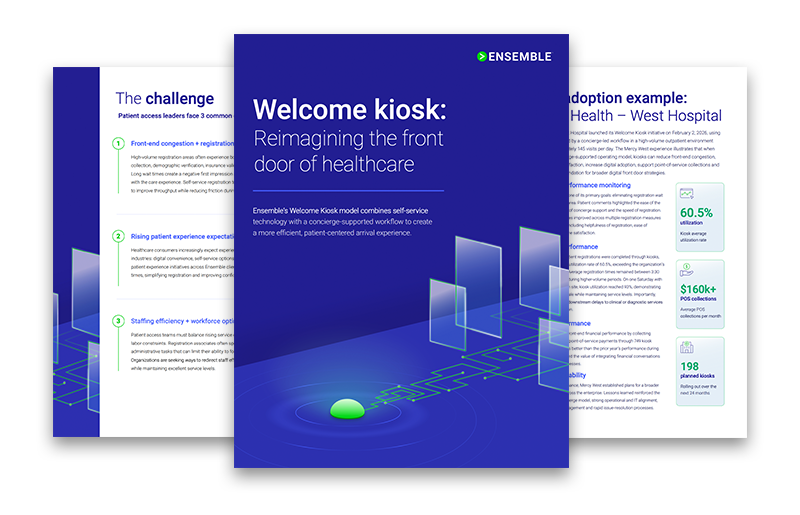
Mercy Health – West Hospital launched its Welcome Kiosk initiative in February 2026. The outpatient location averaged approximately 145 visits per day and introduced two kiosks supported by a concierge-led workflow.
The model shifts associates from clerical processing to patient advocacy and service excellence, and this improvement shows in the results. During the pilot period:
- The program reduced registration wait times in the outpatient area, an improvement for patients and staff alike
- Kiosks completed more than half of outpatient registrations, producing a sustained utilization rate of 60.5%
- Average time to register remained between three minutes, 30 seconds and three minutes, 50 seconds, including during higher-volume periods
- The kiosks also collected more than $160,000 in point-of-service payments through 749 transactions.
Based on initial performance, Mercy West planned a broader enterprise rollout of 198 kiosks.
What does successful implementation require?
Healthcare organizations need a structured approach that includes change management, concierge training, process design and continuous performance monitoring. Lobby layouts, escalation paths, registrar processes and technology configuration should be aligned before launch.