


The short answer
Revenue cycle outsourcing does not mean handing over control, eliminating your revenue cycle team or replacing your EHR investment. In an end-to-end partnership, your organization keeps strategic control and governance, most revenue cycle associates transition to the partner and continue serving the same community, and your EHR remains the system of record. What changes is accountability: one partner owns performance across the full revenue cycle instead of 15 to 30 vendors owning pieces of it.
Hospital and health system leaders evaluating revenue cycle outsourcing tend to ask the same questions — usually in the same order, and usually about control, people, cost and technology. Those questions deserve direct answers, because the wrong assumption can stall a decision that affects margin for a decade.
Here are common concerns that come up most often in executive conversations. We look at what the evidence shows and the questions to ask before choosing a partner:
What is revenue cycle outsourcing?
Revenue cycle outsourcing is the practice of transferring management of revenue cycle operations to a specialized external partner. That work spans patient registration, insurance verification, financial clearance, coding, charge capture, billing, denials management, collections and payment posting.
Outsourcing arrangements fall into three broad categories:
- Point outsourcing: a single function — coding, complex claims or underpayment recovery — is contracted to a vendor.
- Partial outsourcing: mid- and back-office functions move to a vendor while patient access stays in-house.
- End-to-end partnership: one partner manages the full revenue cycle — front, middle and back office — under a single accountability model with shared performance targets and governance.
The distinction matters, because most of the misconceptions that follow trace back to experience with the first two models.
By the numbers
The average health system manages 15 to 30 RCM vendors. Fragmented revenue cycle operations leak more than 5% of net revenue through gaps across denials, clinical documentation, coding integrity, charge capture, underpayments and coverage discovery.
Why are more hospitals outsourcing their revenue cycle?
Hospitals are outsourcing because denials are rising faster than internal teams can absorb, and because the technology required to keep pace with payers is beyond what most single health systems can build alone.
- Inpatient denials have increased more than 50% in the last five years, and even top-performing hospitals lose 2% to 4% of net revenue to denials each year after spending significantly to fight for payment (Kodiak RCA Benchmark Report, August 2024).
- Nearly 30% of denials are triggered by unpublished payer policies that never appear in the provider manual, based on Ensemble’s analysis of more than 60,000 denial audit letters.
- 83% of hospitals and 91% of large physician groups planned to expand or initiate third-party RCM partnerships within a year, up from 68% in 2023 (Black Book Research, Q2 2025).
- New end-to-end revenue cycle outsourcing contracts nearly doubled from 8 to 14 between July 2023 and May 2025 (KLAS Research, End-to-End Revenue Cycle Outsourcing 2025).
- The healthcare RCM outsourcing market is projected to grow from $34.5 billion in 2025 to $40.7 billion in 2026 (The Business Research Company, February 2026).
- 63% of healthcare CFOs plan to dedicate more time to revenue cycle operations in the coming years (HFMA, The Healthcare CFO of the Future, 2025).
Misconception 1: Does outsourcing mean giving up control of performance?
No. You keep strategic control — and most leaders report gaining visibility they didn’t have before to empower more strategic decision-making.
In an end-to-end partnership, the health system retains executive ownership of revenue cycle strategy, sets the KPIs that matter most and approves policy decisions. What shifts is who manages the daily work and who is answerable when a metric slips.
Control is preserved through governance, not headcount. A credible partner will propose a formal, multi-tier structure:
- Daily operational oversight — issue identification and resolution across in-scope and out-of-scope areas, run by cross-functional committees for denial prevention, managed care, utilization management and patient experience.
- Monthly partnership review — performance by service line, committee findings and issue resolution with your CFO and department leaders.
- Quarterly steering committee — strategic goals, change requests and escalations, with contractual decisions escalated to an executive committee.
Health systems that describe outsourcing as a loss of control are usually describing a fragmented vendor stack, where no single party can be held responsible for an outcome.
"We went through a pretty exhaustive process when deciding whether to insource, outsource or do a hybrid approach. We realized that even though we said we were insourced, we were actually working with several revenue cycle firms and managing vendor relationships. There were gaps, and things were getting missed... We needed one source of truth and one partner to hold accountable."
Health system CEO/President, KLAS Research interview, July 2025
Ask a prospective partner: Who is accountable when denials rise next quarter, what does the contract require you to do about it and how is that measured?
Misconception 2: Does outsourcing mean my people get laid off?
In an end-to-end RCM model, many revenue cycle associates transition to the partner and continue serving the same community. Displacement is a model choice, not an inevitability.
Models vary widely, and this is an important thing to pressure-test early. Some firms restructure aggressively. Others use rebadging: associates move to the partner’s payroll, keep their roles and often remain embedded on-site at the hospitals they already serve.
KLAS found that all four firms with validated recent end-to-end selections use rebadging as a core element of their model, transferring a substantial portion of client revenue cycle staff and sub-executive leadership while the health system retains key oversight leaders.
“The goal is often not to cut jobs but to expand career opportunities for existing staff and arm them with more comprehensive resources.”
Brad Gingerich, Vice President of Payer Strategy, Ensemble, on the Becker’s CFO + Revenue Cycle Podcast
Questions to ask about the impact to your people in both the short and long term:
- What percentage of revenue cycle staff transitioned in your last five engagements — and what percentage remained after 12 months?
- What happens to pay, PTO, benefits and seniority on day one?
- Which leadership roles stay with us and which move to you?
- Will you share 30- and 60-day post-transition associate satisfaction survey results?
Misconception 3: Is outsourcing primarily a cost play?
Rather than cost savings, the larger financial impact is net revenue — collecting what the organization has already earned.
Labor arbitrage defined the first generation of revenue cycle outsourcing. Point solutions defined the second. Revenue cycle 3.0 is different: unified orchestration across the entire encounter, combining end-to-end data, agentic automation and certified operators working from one standard operating model.
Measured against industry benchmarks, Ensemble’s 2025 client results show where that value shows up:
Metric
Initial
denial rate
Final
denial rate
AR greater
than 90 days
Unbilled days
Ensemble
clients (2025)
8.0%
2.8%
26.7%
3.4
Industry
benchmark
11.8%
3.0%
29.8%
4.6
Across its client base, Ensemble delivers an average 5% net patient revenue improvement, which means the opportunity is not just reducing expense but capturing revenue the organization has already earned. For a health system with $1.5 billion in annual net patient revenue, even one point of improvement represents $15 million, shifting the conversation from FTE reduction to measurable financial performance.
A business case built on headcount reduction alone is usually a signal that the scope is too narrow to move the metrics that matter.
Misconception 4: Does outsourcing mean replacing our existing systems?
No. A strong partner amplifies your existing systems rather than replacing them. The EHR remains the source of truth.
Ensemble helps health systems get more from their existing EHR investment. With more than 130 certified analysts in multiple platforms, experience across Epic environments and participation in Epic’s Rev Cyclers program, our focus is configuration, optimization and governance — not duplication or replacement of your existing system.
Questions to ask about technology:
- Does your model amplify our existing systems or require replacement?
- How many of your analysts are certified in the specific modules we use?
- Who owns EHR governance and build decisions after go-live?
- What automation and AI use cases are live across your client base today, which workflows are fully deployed versus in pilot and what specific results have they produced?
Misconception 5: Do AI + outsourcing together mean fewer opportunities for our people?
AI is changing what revenue cycle work looks like, and the shift is toward higher-judgment roles. The greater risk is standing still while payers automate faster.
In the coming years, payers could see 3% to 12% higher revenue and substantial administrative and medical cost savings through AI and automation, according to McKinsey.
Here is what automation has produced inside Ensemble operations, with certified human operators always in the loop:
- 96% patient call satisfaction with AI-enhanced engagement
- 50% reduction in patient call abandonment using HIPAA-compliant natural voice agents
- 35% faster call response times aided by real-time call notation technology
- 17% better DRG and coding accuracy supported by expert operators
- 41% fewer initial denials powered by AI
- 46% reduction in unbilled days for accelerated payment
Every one of those gains redirects human effort toward exceptions, appeals, payer strategy and patient conversations — work that requires judgment. Ask a prospective partner about certification support, upskilling paths and internal mobility, and press for specifics.
Misconception 6: Does implementation take years?
No. A proven end-to-end transition can run about 120 days from signature to go-live, with measurable performance improvement beginning in as little as 90 days.
A realistic timeline looks like this:
- Before signature — assess and align. Conduct a cost-to-collect analysis, map processes, inventory existing vendors and document a performance baseline. Executives who skip this step lose leverage later, because fee baselines may be calculated differently than you have historically calculated them.
- Days 1 to 30 — stand up governance. Launch joint steering committees, engage HR, communications and IT early and build the coordinated plan 30 to 60 days ahead of the transition, covering internal announcements, external media, FAQs and direct touchpoints with transitioning associates.
- Days 30 to 90 — prepare people and systems. Finalize associate transition logistics, deliver training, standardize processes and complete technology integration and system access.
- Around day 120 — go live. Associates transition, standard operating models activate and daily operational reviews begin.
- Days 120 to 365 — stabilize, then optimize. Denial prevention committees, payer escalation, clinical documentation initiatives and automation deployment compound results through year one.
There is no fixed end date. An end-to-end partnership is an operating model rather than a project, and contracts commonly run five to ten years. Health systems can and do separate from underperforming partners when expectations are not met, which is exactly why references, third-party validation and contract terms deserve scrutiny up front.
Year-one results for one midwestern health system
- Cash collections reached 102% of goal, a 1.5% improvement over baseline.
- Net AR days dropped 17.5 days; insurance AR over 90 days fell 7.6 points.
- Total unbilled days fell 4.9 days; final denials dropped 3.5% of net patient service revenue.
- Call center average speed-to-answer went from 1 minute 9 seconds to 9 seconds, with a 75% reduction in call abandonment.
- 93% of patients said they were “very likely” to seek future care with the health system.
- Go-live took place roughly 60 days after partnership selection.
Ask a prospective partner: “Walk us through days 1 to 120 at your last three go-lives — including what slipped and how you recovered.”
What are the benefits of outsourcing revenue cycle management?
The average health system manages 15-30 RCM vendors. A unified, end-to-end RCM partnership model, however, covers the entire revenue cycle — including front, middle and back office — under one operating model, one governance structure and one set of shared performance goals. That matters because revenue cycle problems rarely stay confined to one function. A registration error can trigger an authorization issue, a documentation gap can become a coding concern and a payer policy change can move from denial prevention to appeals within days.
When multiple vendors own separate pieces of that chain, leaders are left coordinating handoffs, reconciling conflicting reports and determining where accountability begins and ends. With a single end-to-end partner, the organization has one team responsible for connecting the dots, acting on root causes and improving performance across the full encounter instead of optimizing isolated processes.
"Having a single partner with a singular focus who brings accountability and investment [to the revenue cycle] has been a game changer compared to juggling multiple vendors."
Health System CEO/President KLAS Research Survey, August 2025
Outsourcing to a single end-to-end partner also delivers four benefits that fragmented models struggle to produce:
- Stronger revenue cycle performance
- Reduced administrative burden and cost
- A better patient financial experience
- More reliable financial forecasting
Improved revenue cycle performance
A specialized partner brings accurate coding practices, disciplined claims management and denial prevention built on data most single systems cannot assemble. Ensemble manages more than 80 million claims transactions a year and has unified more than two petabytes of provider, payer and clinical data, which powers predictive modeling, anomaly detection and early intervention before a claim goes out the door, reducing thousands of dollars in lost time and revenue.
Reduced administrative burden + cost
Managing revenue cycle in-house means carrying infrastructure, technology investment and recruiting in a tight labor market. A partner spreads those costs across a client base and absorbs the work of tracking constantly changing payer rules, compliance requirements and regulatory shifts.
Enhanced patient experience
Billing errors, surprise statements and long waits for financial clearance erode trust in a hospital as quickly as any clinical issue. Streamlined financial clearance, accurate estimates, digital payment options and fast, resolved phone calls give patients one less thing to worry about during care.
Better financial forecasting + management
Comprehensive reporting on KPIs, revenue trends and leakage points gives finance leaders the visibility to forecast confidently and intervene early. That visibility is the single most common gap health systems name when they describe their existing vendor stack.
"The firm is great to work with. Our senior leaders will reach out to the firm, ask questions, and get prompt, detailed feedback. Ensemble's analytics and consistent desire to add value are emblematic of a great partnership. They implemented a new service for all their clients. We didn't ask for that, but the firm had the ability to add value, so they did."
Health System CFO, April 2023, Collected by KLAS Research
What are the real risks of revenue cycle outsourcing?
Revenue cycle risks are real, and each is manageable with the right diligence.
Risk
How to
mitigate it
Diluted accountability across multiple vendors
Consolidate scope. Confirm the partner covers the entire scope required so no issue can be attributed to a gap between vendors.
Baseline + performance fee disputes
Settle how baselines and performance fees are calculated before signing. Vendor methodology often differs from how you have historically measured.
Transition disruption
Require a detailed implementation plan with milestones, named leads and success metrics. Engage HR and IT from day one.
Data security + privacy exposure
Review security protocols, audit history, business continuity plans and cyber incident response commitments in writing.
Contract terms that age poorly
Review auto-renewal notice windows, exit and data portability terms, SLA measurement methodology and out-of-scope pricing.
Cultural mismatch
Meet the leaders who will run your account, not just the sales team. Ask how they handle setbacks.
What should you look for in an RCM outsourcing partner?
Before choosing a partner, pressure-test what really determines success: accountability, integration, technology, governance and long-term value. These five criteria show what to ask and what credible answers should include.
1. Make sure values + goals align
A strong partnership requires shared priorities and cultural fit. Look for well-defined procedures for onboarding, associate integration and performance reporting — and evaluate exactly what happens to your people.
- How do you ensure alignment with our organizational goals?
- How do you handle cultural integration between organizations?
- How do you measure success during and after implementation?
Green flag: The partner can articulate specific integration procedures, provides a named implementation lead and offers transparent performance reporting from day one.
2. Verify their track record
Don’t rely on promises — confirm performance. Talk directly with clients of similar size, complexity and region, and look for third-party validation.
- Can you provide references from clients of similar size and complexity?
- What measurable results have you delivered for them?
- What experience do you have in our region?
Green flag: Direct access to reference clients, specific financial outcomes and recognized industry validation such as Best in KLAS, HFMA MAP Awards or Black Book rankings.
3. Assess technology infrastructure + approach to innovation
Evaluate the platform, security protocols and integration approach with your EHR. Ask for live use cases, adoption data and measured results, not roadmap slides. A credible partner should be able to show where automation or AI is already in production, how it integrates with your EHR, who governs processes and what performance improvement it has delivered.
- What technology capabilities do you have and how do they integrate with our existing systems?
- What data security measures are in place?
- What types of automation and AI are live across your client base today, and what are the specific use cases?
- How do you monitor AI accuracy, handle exceptions and maintain compliance when automation is used in daily revenue cycle processes?
Green flag: Production AI and automation use cases with adoption data, measurable outcomes, named client references, EHR integration and clear governance for accuracy, exceptions and compliance.
4. Insist on shared decision-making
Governance should be collaborative. Establish steering committees, escalation paths and a regular communication cadence before go-live.
- Will a joint steering committee be established, and when?
- How will you involve our leadership in policy and process decisions?
- What communication cadence do you recommend?
Green flag: A formal governance structure with daily, monthly and quarterly touchpoints that includes your leadership in strategic decisions, not just status updates.
5. Look for ongoing value
The best partners bring strategic insight beyond daily operations — payer policy guidance, denial prevention recommendations and support for issues outside contracted scope.
- How will you keep us informed about payer policy changes?
- Will you provide recommendations to reduce denials and audits?
- How do you identify and resolve issues outside of contracted scope?
Green flag: Payer strategy support, proactive denial prevention guidance and out-of-scope issue resolution offered as standard rather than as an upsell.
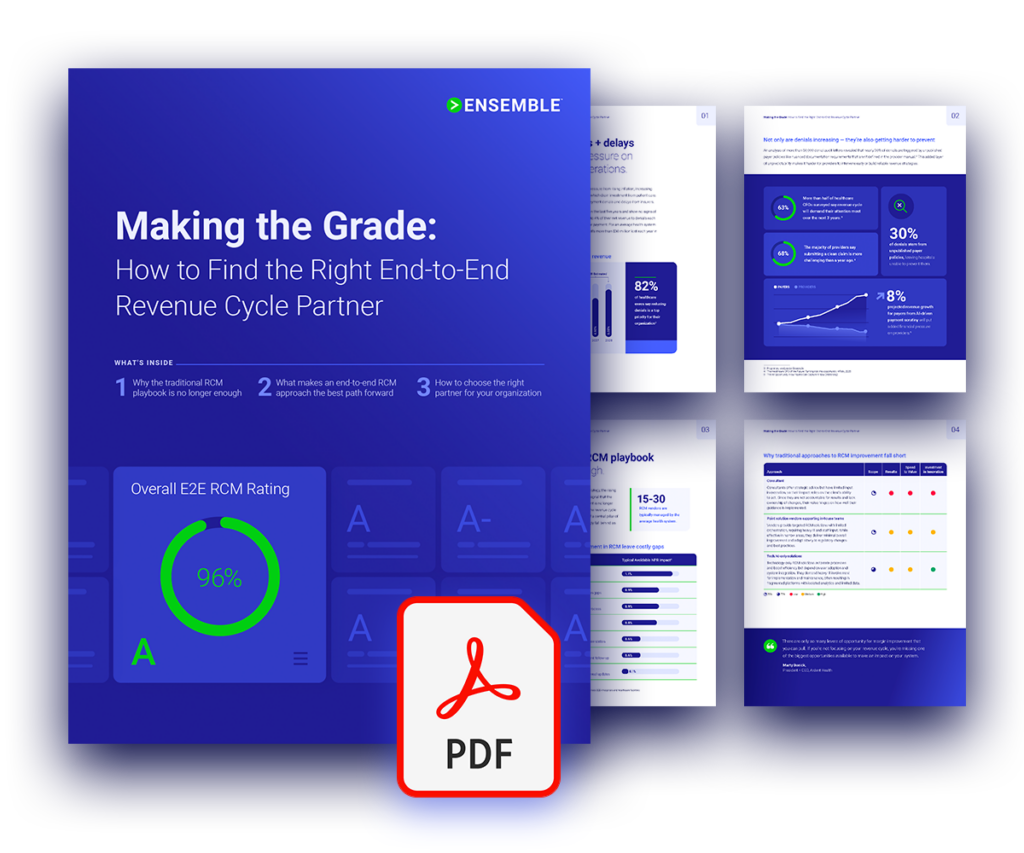
Making the Grade: How to Find the Right End-to-End Revenue Cycle Partner covers the full evaluation framework, onboarding best practices and third-party research benchmarks.
Revenue cycle outsourcing FAQs
Does outsourcing the revenue cycle mean losing control of performance?
No. The health system keeps strategic control, KPI ownership and policy authority. The partner manages daily execution and is accountable for results through formal governance: daily operational oversight, monthly partnership reviews and quarterly steering committee meetings, with contractual decisions escalated to an executive committee.
Will my revenue cycle staff lose their jobs if we outsource?
In an end-to-end partnership, many revenue cycle associates transition to the partner and continue serving the same community, often on-site at the same facilities. KLAS found that all four firms with validated recent end-to-end selections use rebadging as a core element of their model. Displacement varies by firm, so confirm the model in writing before you sign.
Is revenue cycle outsourcing mainly a cost-cutting measure?
No. The larger impact is net revenue improvement. Ensemble clients see an average 5% net patient revenue improvement, with an 8.0% initial denial rate against an 11.8% industry benchmark and 26.7% of AR over 90 days against a 29.8% benchmark.
Do we have to replace our EHR or Epic investment?
No. Your EHR remains the source of truth. Ensemble supports many different EHRs across its client base and maintains more than 90 certified analysts working across multiple EHR instances, focused on optimization, governance and early adoption EHR capabilities.
How long does implementation take?
A proven end-to-end onboarding typically reaches go-live in about 120 days, with performance improvement beginning in as little as 90 days after. Strong success markers can be seen within the first year. In partnership with Ensemble, nonprofit health system Valley Health rapidly integrated advanced technology with existing systems, filled staffing gaps and implemented best practice processes. As a result, within the first year of partnership, Valley Health exceeded its year-one cash collection goal and increased its net revenue by $20 million, all while helping strengthen the patient experience.
What happens to revenue cycle jobs as AI adoption increases?
AI is shifting revenue cycle work toward higher-judgment roles — exceptions, complex appeals, payer strategy and patient conversations — while automation absorbs repetitive tasks. Ask any partner about certification support, upskilling paths and internal mobility, and ask for specific numbers.
What’s the difference between an RCM consultant, a point solution and an end-to-end partner?
These approaches to RCM differ in scope. Consultants diagnose problems but do not own execution or outcomes. Point solutions improve a single function but leave upstream and downstream issues untouched, adding to the vendor sprawl that causes leakage. Tech-only tools can automate a flawed process faster. An end-to-end partner combines operations, accountability and technology in one model with enterprise-wide scope.
How do we measure success with an RCM outsourcing partner?
Define measurable targets in the contract before go-live: cash collections as a percentage of goal, net AR days, AR over 90 days, initial and final denial rates, unbilled days, cost to collect and patient experience measures such as speed to answer and first-call resolution. Require a shared dashboard so both organizations work from the same source of truth.
How is patient data protected when we outsource?
Ask for documented HIPAA safeguards, access controls, audit history, third-party security certifications, business continuity plans and cyber incident response commitments. Ask specifically what the partner did during recent industry-wide disruptions and whether recovery support carried additional cost.
Who owns payer contract negotiations after we outsource?
The health system does. A strong partner supports negotiations with payer performance data, cross-market visibility into payer behavior and escalation support such as demand letters and state complaints. Confirm whether payer strategy support is included in the base agreement or priced separately.
Choosing the right partner is the decision that matters
Revenue cycle outsourcing is a long-term operational commitment with real financial consequences. The misconceptions above are worth clearing early, because the organizations that get the most value are the ones that ask harder questions before signing — about accountability, people, technology and governance.
Ensemble has been named Best in KLAS for end-to-end revenue cycle outsourcing six times, with a most recent score of 96.9 out of 100. We support hundreds of hospitals and oversee more than $55 billion in annual net patient revenue. 100% of clients say they would partner again.
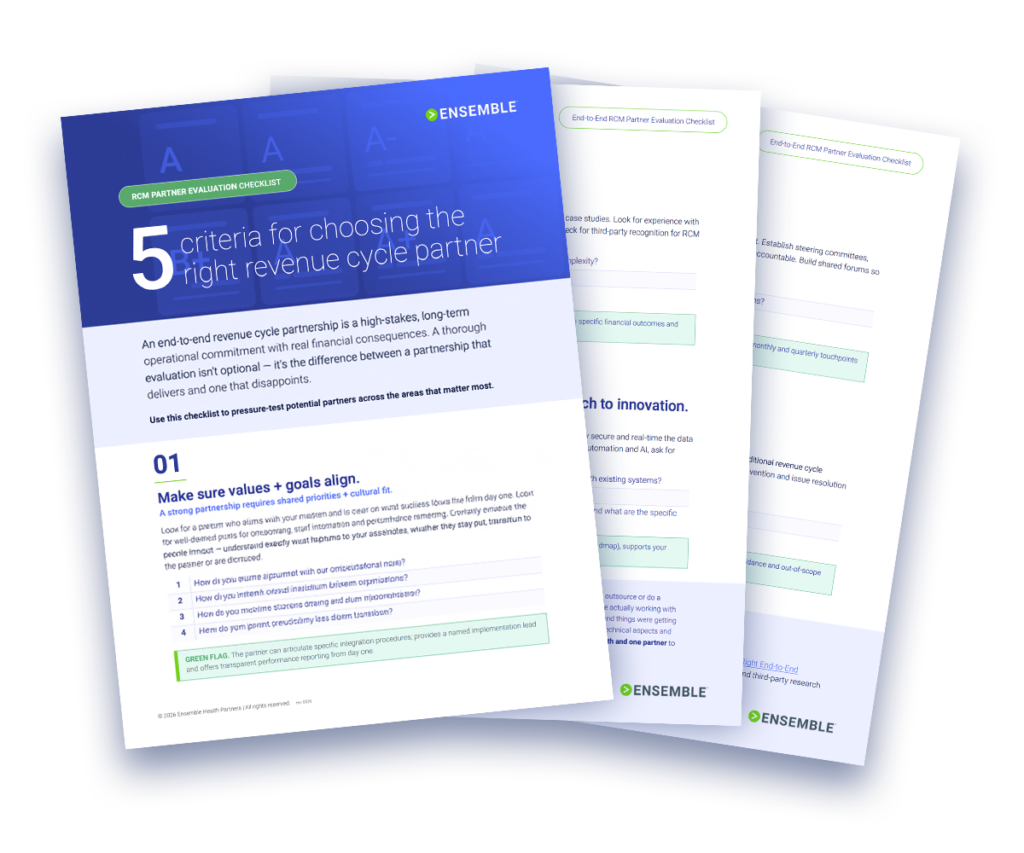
Get the RCM Partner Evaluation Checklist featuring five criteria, the questions to ask and the green flags to look for.